A Slow Walk Through a Place Name
Explore a familiar place name by listening to its sound, checking its spelling and reading its landscape as clues without treating a guess as fact.
You pass a lane sign for Bracken Mere on the way to the shops, and the name seems to belong to the place as naturally as the bends in the road. A slow walk through a place name starts with that small pause: say the name aloud, look at the ground around it, and resist settling on a meaning before the clues have had time to gather.
This is a way to notice, not a method for proving a name’s origin. Pronunciation, spelling and landscape can point towards useful questions, but names change as people speak, write and reshape their surroundings. The aim is to leave with a more attentive account of the place, including what remains uncertain.
Begin with the name as people use it
Start where the name is spoken or written: a road sign, a bus stop, a local noticeboard or an address on a letter. Note the exact form, including spacing and any unusual letters. Then listen for how a resident, shopkeeper or bus driver says it, if the chance arises naturally.
Keep your own first impression separate from what you hear. Write down a simple phonetic reminder in ordinary language, such as “first syllable like branch” or “the final vowel is barely voiced”. Avoid turning that note into a claim about an older language. Modern pronunciation is evidence of present use, not a recording of the name’s earliest form.
Ask yourself what the sound makes you expect. A name may seem to contain a familiar word, or its rhythm may suggest a phrase. Treat that response as a prompt to investigate. Similar sounds can arise by coincidence, and a place name can preserve a form that no longer resembles everyday speech.
Record spelling before you interpret it
Spelling offers another kind of clue, but it has its own history. A sign may use a standardised form; an older local document may spell the same name differently; and handwriting or copying can introduce variation. If you encounter more than one version, note where each appears and keep them side by side rather than choosing a winner straight away.
For a modest local enquiry, useful places to look include a public library’s local-history shelf, a parish or community map, and catalogue entries for historical maps. A modern Ordnance Survey map can help you locate the named feature, while an older map may show a different spelling or a landmark that has since disappeared. Map editions and archival records vary in coverage, so record the source and its date when these are clearly given.
Do not assume that an older-looking spelling must be closer to the original. It may be a clerk’s attempt to write a sound, a printer’s convention or an error repeated later. The practical question is narrower: which forms are documented, where do they occur, and what changed between them?
Let the setting supply questions
Walk the area at an ordinary pace. Notice slopes, exposed rock, wet ground, tree cover, paths, field edges and the position of houses. A name that appears to refer to water can be compared with the present drainage, but a stream may have been diverted, culverted or renamed. A rise in the ground can be visible from one direction and hidden from another.
Use a paper map or an offline mapping app to keep your bearings, then look up from the screen. Mark where the name appears and what physical feature it identifies: a settlement, road, field, hill, bridge or watercourse. That distinction matters. A name attached to a village may not describe the nearest hill, even if the hill seems to fit a tempting interpretation.
Landscape clues are not translations. A marshy patch does not prove that a name means “wet ground”; the water may be recent, seasonal or the result of drainage changes. Instead, write a question you could check: “Does this low area remain wet after dry weather?” or “Does the name label the stream, or the settlement beside it?” This keeps observation useful without making it carry more weight than it can bear.
Follow one invented walk from guess to better question
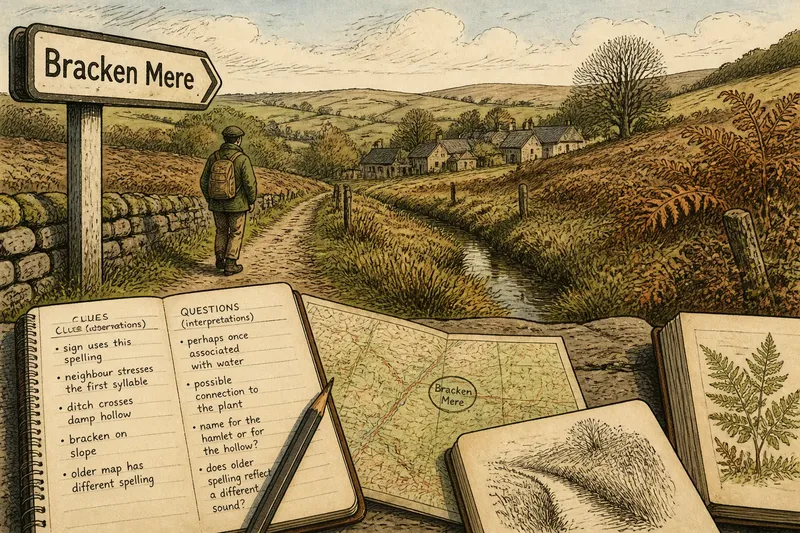
Imagine that you live near the fictional hamlet of Bracken Mere. You have always heard the name as two familiar words: bracken, the plant, and mere, a lake. On a quiet walk, you begin at the sign at the lane junction and record the spelling exactly. A neighbour, encountered while walking a dog, pronounces the first part with a short vowel and barely stresses the second. That does not settle the name, but it warns you that your tidy two-word reading may reflect modern spelling more than local speech.
You follow the public footpath towards the low ground shown on your map. There is a narrow drainage ditch, a damp hollow and a patch of bracken on the slope, but no obvious lake. You note each feature without treating any as the answer. On a library visit, you find that a local map lists a slightly different spelling, while a later street map uses the form on the sign. You do not infer a translation from that change; you add it to your notes as a spelling variation worth checking.
The useful result is not “Bracken Mere means a lake among bracken”. It is a sharper set of questions: did the name once refer to water that is no longer visible, does the older spelling represent a different sound, and is the name attached to the hamlet or to the hollow? The walk has turned a confident guess into a small, traceable enquiry. If you wanted to continue, you could ask a local-history group where its map references came from, or search a library catalogue for records under both spellings.
Keep clues and claims in separate columns
A two-column note is enough to stop an attractive idea from outrunning its evidence. Put direct observations on one side and possible interpretations on the other. For Bracken Mere, the first column might contain “sign uses this spelling”, “neighbour stresses the first syllable” and “ditch crosses damp hollow”. The second could say “perhaps once associated with water” and “possible connection to the plant”. Label those as ideas, not findings.
When you consult a dictionary of place-name elements or an authoritative local reference work, check whether it gives a documented early form and explains its reasoning. A short gloss without evidence may be a useful lead, but it should not erase uncertainty. If reliable sources disagree, note the disagreement and the basis each source offers. Names can be old, altered and locally interpreted at the same time.
- Sound: Record how people pronounce the name, without correcting them to match the spelling.
- Spelling: Copy each form exactly and note where you found it.
- Feature: Identify what the name labels, rather than assuming it describes the nearest landmark.
- Setting: Describe what is visible now and what may have changed.
- Confidence: Mark each proposed meaning as a question, a plausible reading or a documented interpretation.
Questions to carry on the walk?
Can I work out a place name from its modern spelling?
Not reliably on spelling alone. Use it to form possibilities, then compare pronunciation, documented forms and the feature the name identifies.
Should I ask local people how they say it?
Yes, if the conversation is welcome and you treat the answer as evidence of current usage. One person’s pronunciation may differ from another’s, so note what you heard rather than declaring a single form correct.
What if the landscape seems to contradict the name?
Record the mismatch instead of forcing an explanation. The named feature may have changed, may be hidden, or may never have been the feature you assumed.
Where can I check older spellings?
Try a local library, historical map collection or local-history group, and keep the source details with each spelling. Coverage and interpretation vary, so a map entry is a clue rather than a complete account.
Leave room for what the walk cannot tell you
A place name can carry several layers: an old sound adapted to new speech, a spelling settled by a mapmaker, and a landscape altered by drainage or building. A walk can reveal the present setting and sharpen the questions, but it cannot by itself date a name or identify its first meaning.
Next time a familiar sign catches your eye, take a note of the wording, say it as local speakers do, and look at the feature it actually names. That modest record gives any later explanation something solid to meet: observed details, traceable spellings and a clear boundary between a clue and a claim.